


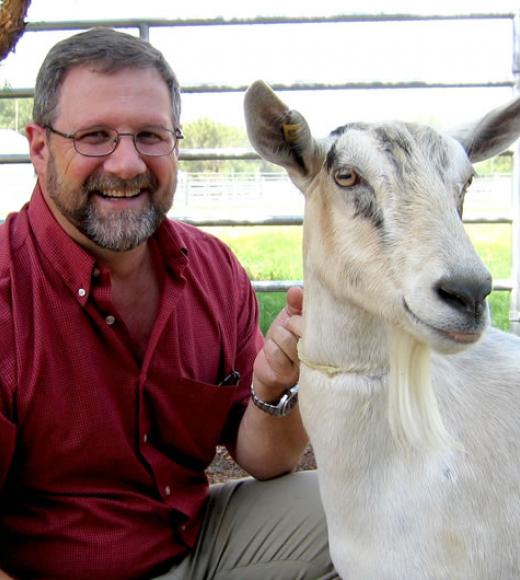
Position Title
Professor Emeritus
Hired 1989, Retired 2021
Education
- B.S., University of Wyoming, Laramie, 1974 Zoology and Physiology.
- M.S., University of Wyoming, Laramie, 1975 Zoology and Physiology.
- Ph.D., Macquarie University, Australia, 1980 Biology (genetics).
- Fellow American Association for the Advancement of Science.
- Member: International Society Transgenic Technologists, American Dairy Science Association, American Association for the Advancement of Science.
Research Interests
My research program is divided between to areas: genetic engineering of mammals and horse genomics. Within the work centered on transgenic animal biology we work on a number of gene systems designed either as research models (ovine growth hormone transgenic mice) or to livestock for use in agriculture. Within the latter area we are focused on manipulating the mammary gland to improve the properties of milk for human consumption. We also carry out work to improve the technology associated with genetically engineering large animals.
Additional information about Dr. Murray's research
Graduate Students
I am currently a member of the Integrated Genetics and Genomics Graduate Group and the Animal Biology Graduate Group. Both groups have programs leading to the M.S. and Ph.D. degrees. Currently I have two Ph.D. students.
Professional Activities
Advisory Editorial Board member - Journal of Biomedicine and Biotechnology.
Chair of the organizing committee for the bi-annual U.C. Davis Transgenic Animal Research Conference, a three-day international meeting on the topic of transgenic animals in research. Abstracts of presentations and posters for meetings 2 through 11 may be found in Transgenic Research. The twelth meeting is currently being planned for August 2019.
Chair of the UC Davis Animal Science department 2017-2021.
Graduate Groups
Courses Taught
- Introductory Animal Science (ANS2)
- Molecular Biology Laboratory Techniques (ANG111)
- Lower Division Seminar (SAS90E)
People
Current Graduate Students
- Ellen Harness, PhD Program, Animal Biology Graduate Group. Expected Graduation Date: Summer 2020.
- Sadie Hennig, MS Program, Animal Biology Graduate Group. Expected Graduation Date: Summer 2017.
- Jamie Randol, MS Program, Animal Biology Graduate Group. Expected Graduation Date: Summer 2016.
- Erica Scott, PhD Program, Animal Biology Graduate Group. Expected Graduation Date: Summer 2017.
Alumni
- Asha Miles, M.S. Animal Biology Graduate Group, Fall 2015.
Selected Publications
Transgenic technology:
Feltrin, C., Cooper, C.A., Fauzi, N.M, Rodrigues, V.H.V., de Aguiar, L.H., Gaudencio Neto, S., Martins, L.T., Calderón, C.E.M., Morais, A.S., Cameiro, I. de S., de Almeida, T.M., da Silva, I.N.G., Rodrigues, J.L., Maga, E.A., Murray, J.D., Libório, A.B., Bertolini, L.R. and Bertolini, M. (2014) Systemic immunosuppression by methylprednisolone and pregnancy rates in goats undergoing the transfer of cloned embryos. Repro. Domestic Animal 49:648-656.
Garas, L., Murray, J.D., and Maga, E.A. (2015) Genetically engineered livestock: Ethical use for food and medical models. Annual Review of Animal Biosciences 3:1.1–1.17. doi:10.1146/annurev-animal-022114-110739
Murray, J.D. and Maga, E.A. (2016). A new paradigm for regulating genetically engineered animals that are used as food. PNAS 113:3410–3413. doi/10.1073/pnas.1602474113
Murray, J.D. and Maga, E.A. (2017).Transgenic Livestock for use in Agriculture in Animal Biotechnology 2: Emerging Breeding Technologies (Editors: H. Niemann & C. Wrenzycki). Springer. In press
Transgene biology:
Cooper C.A., Maga E.A., Murray J.D. (2014) Consumption of transgenic milk containing the antimicrobials lactoferrin and lysozyme separately and in conjunction by 6 week old pigs improves intestinal and systemic health. J Dairy Research 81:30-37.
Cooper, C.A., Nonnecke, E., Lonnerdal, B. and Murray, J.D. (2014).The lactoferrin receptor may mediate the reduction of eosinophils in the duodenum of pigs consuming milk containing recombinant human lactoferrin. BioMetals. 27:1031-8. Doi:10.1007/s10534-014-9778-8
Bertolini, L., Bertolini, M., Murray, J.D. and Maga, E. (2014). Transgenic animal models for the production of human immunocompounds in milk to prevent diarrhea, malnourishment and child mortality:perspectives for the Brazilian Semi-Arid region. BMC Proceedings 8 (Suppl 4):O30 http://www.biomedcentral.com/1753-6561/8/S4/O30
Cooper, C.A., Maga, E.A. and Murray, J.D. (2015). Production of human lactoferrin and lysozyme in the milk of transgenic dairy animals: Past, present and future. Transgenic Research 24:605–614 DOI 10.1007/s11248-015-9885-5
Murray, J.D. and Maga, E.A. (2016). Genetically Engineered Livestock for Agriculture: A generation after the first Transgenic Animal Research Conference. Transgenic Research 25:321-327.
Garas, L.C., Feltrin, C., Hamilton, M.K., Hagey, J.V., Murray, J.D., Bertolini, L.R., Bertolini, M., Raybould, H.E. and Elizabeth A. Maga, E.A. (2016) Milk with and without lactoferrin can influence intestinal damage in a pig model of malnutrition. Food and Function 7:665-678.
Horse genetics and genomics:
Scott, E.Y., Penedo, M.C.T., Murray, J.D. and Finno, C.J. (2016). Defining Trends in Global
Gene Expression in Arabian Horses with Cerebellar Abiotrophy. Cerebellum 16:462–472. DOI 10.1007/s12311-016-0823-8
Mansour, T.A., Scott, E.Y., Finno, C.J., Bellone, R.R., Mienaltowski, M.J., Penedo, M.C.T.,
Ross, P.J., Valberg, S.J., Murray, J.D. and Brown, C.T. (2017). Tissue Resolved, Gene Structure Refined Equine Transcriptome. BMC Genomics 18:103. doi: 10.1186/s12864-016-3451-2.
Scott, E.Y., Mansour, T., Bellone, R.R., Brown, C.T., Mienaltowski, M.J., Penedo, M.C., Ross, P.J., Valberg, S.J., Murray, J.D. and Finno, C.J. (2017). Identification of long non-coding RNA in the horse transcriptome. BMC Genomics 18:511. DOI 10.1186/s12864-017-3884-2
Patents
Murray, J.D., Maga, E.A., Anderson, G.B., and Oppenheim, S.M. (2007). Method of Generating a Transgenic Livestock Animal. U.S. Patent Number 7,199,281 B2.
Murray, J.D. and Maga, E.A. (2007). Stearoyl Co-A Desaturase Transgenic Non-human Animals. U.S. Patent Number 7,244,874.